Sequence · 20 min
Twenty-Minute Chair-Supported Gentle Practice
A full practice for the days when getting down to the floor and back up again is the hardest part. Every pose here has something holding it up — a chair, a block, or both — so the muscles can work far below their limit and the joints stay comfortable.
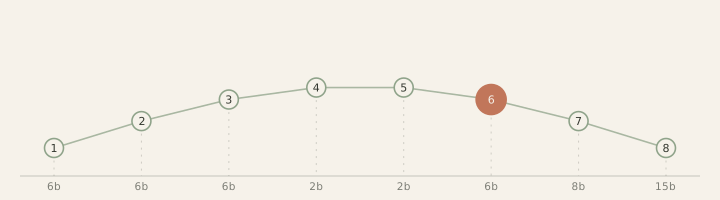
- 01
 Mountain PoseTāḍāsanaStand behind the chair with both hands resting on the back of it.
 - 02
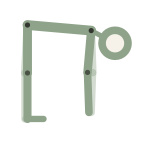 Standing Forward FoldUttānāsanaHands on the chair seat, hips sliding back; the chair sets the depth so you do not have to.
 - 03
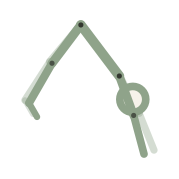 Downward-Facing DogAdho Mukha ŚvānāsanaHands on the seat of a chair, feet back, spine long — a standing version with no wrist load.
 - 04
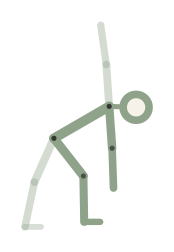 Triangle PoseTrikoṇāsanaLeft leg forward, bottom hand on a block at its highest setting.
 - 05Triangle PoseTrikoṇāsanaRight leg forward, same setup. Nothing reaches; everything rests.
- 06
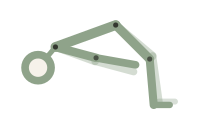 Bridge PoseSetu BandhāsanaBlock under the sacrum, hold long enough for the front of the body to soften.
 - 07
 Child's PoseBālāsanaKnees wide, or forearms on the chair seat and the head resting on the arms.
 - 08
 Corpse PoseŚavāsanaFlat on the mat with a blanket; three minutes minimum.
What support actually changes
| Pose | What holds it up | What you get instead |
|---|---|---|
| Standing forward fold | Hands on the chair seat | Length in the back without loading the hamstrings hard |
| Downward dog | Hands on the chair seat | The spinal traction, none of the wrist extension |
| Triangle | Bottom hand on a high block | A long waist without the balance demand |
| Bridge | Block under the sacrum | A passive opening with no glute work required |
Supporting a pose does not make it a lesser version. It changes which structure carries the load: the chair takes the weight of the torso in the forward fold, so the hamstrings are stretched at maybe 40 percent of their maximum instead of 85 percent, and the lower back stops being asked to hold the fold up at all.
This matters most for the two ends of a practice: people returning after an injury or a long break, and people in their seventies and eighties who want to keep the range they have. In both cases a supported practice done five times a week beats an unsupported one done once.
Working below the limit on purpose
The instruction in this sequence is to stay two or three notches below what you could do. That is not caution for its own sake: at low intensity the nervous system is willing to let range increase, which is why a gentle practice done daily often changes range faster than a hard one done twice a week.
If a pose feels like nothing at all, add a breath rather than adding depth. Longer, softer holds are the point.
This sequence is informational only, not medical advice, and not a substitute for a teacher who can see you move. Skip any step that hurts, and check with a clinician about injuries, pregnancy or recent surgery.