Appears in
- 15'Fifteen-Minute Sunrise Mobility
- 20'Sun Salutation A, Walked Through Slowly
- 20'Twenty-Minute Chair-Supported Gentle Practice
Pairs with
Pose · A
Downward-Facing Dog
Adho Mukha Śvānāsana
An inverted V that is a shoulder pose wearing a hamstring costume. The spine lengthens because the arms push the floor away, and the whole shape falls apart the moment the hands stop doing their share of the work.
The shape, with joint angles
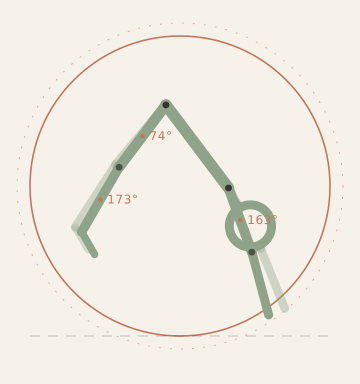
The angles are measured on the drawn skeleton and change with the variant you pick. Treat them as a starting reference, not a target to force.
Specification
| Sanskrit | Adho Mukha Śvānāsana |
|---|---|
| Also called | Down Dog |
| Level | Beginner |
| Loads | Shoulders · Hamstrings · Calves · Spine · Wrists |
| Props | Mat · Block · Strap · Wall |
| Typical hold | 1 min |
| Gaze | |
| Published | 20 August 2026 · By The Asana Desk |
Getting in
- 01
From hands and knees, set the hands shoulder-width, index fingers pointing straight ahead, fingers spread wide.
- 02
Tuck the toes and lift the knees off the floor, keeping the knees bent at first.
- 03
Walk the feet back until the hips are the highest point of the body.
- 04
Press the whole palm down, especially the base of the index finger and the inner heel of the hand.
- 05
Draw the shoulder blades toward the tailbone, then let the head hang between the upper arms without collapsing the neck.
- 06
Keep the knees bent if the lower back rounds; straighten them over weeks, not in one session.
- 07
Hold 45 to 60 seconds, then lower the knees and rest in Child's Pose.
Working notes
The arm that does nothing
| Segment | Measured angle in the figure | Notes for a beginner |
|---|---|---|
| Torso to leg (hip fold) | about 90° between torso and thigh | Knees bent keeps this fold in the hip, not the back |
| Shoulder to torso | about 160° — the arm continues the line of the spine | If the arms angle forward, the shoulders are not over the wrists |
| Ankle | about 90° | Heels reach down; they do not have to touch |
| Upper arm to forearm | about 165°, a soft bend | Locked elbows push the load into the wrists |
In a well-made Down Dog the hands carry roughly a third of the body's weight, and the shoulders sit directly over the wrists with the arms in line with the torso. When the arms go slack, that load transfers to the neck and the lower back, which is why so many people leave the pose with a sore upper back and blame their hamstrings.
A quick diagnostic: at the end of the hold, notice where you feel tired. Arms and upper back means the pose is working as intended. Neck and lower back means the arms gave up.
Pedal the feet, but for the right reason
Pedalling the heels down one at a time is a way of exploring calf length while the pose is already set up. It is not a warm-up and it does not 'open' anything in ten seconds. Two or three slow pedals at the start, then settle into stillness.
If the heels are more than a hand's width off the floor after a month of practice, the limit is calf and hamstring length, not effort. A strap around the top of the shins, or a folded blanket under the heels, keeps the rest of the shape honest while that length arrives.
Self-checks
- Are the shoulders directly above the wrists in side view?
- Is the space between the ears and the inner arms the same on both sides?
- Do the arms feel more tired than the lower back?
Safety
Skip or heavily modify the pose if any of these apply to you. When in doubt, ask a teacher who can see you move, or a clinician who knows your history.
- Carpal tunnel syndrome or wrist pain in flexion: use blocks or a wall to reduce the wrist angle, or skip the pose.
- High blood pressure that is not well controlled: shorten the hold and keep the head above the heart where possible.
- Glaucoma or recent eye surgery: avoid the inverted position.
- Third trimester of pregnancy: use a wall-supported version instead, and check with your midwife.
- Recent shoulder injury or rotator cuff repair: get clearance before loading the arms this way.
This page is informational only. It is not medical advice and no pose here is a treatment for any condition.
- Knees bent, heels lifted, to keep the spine long.
- Hands on blocks or on a wall at hip height, which removes most of the wrist extension.
- Feet on the wall in an L-shape, for a gentler hamstring line.
- Puppy pose (knees down, chest toward the floor) as a substitute whenever the shoulders complain.
Useful propsMat · Block · Strap · Wall
- A strap around the upper shins teaches the inward hug of the legs that keeps the pose from splaying.
- A rolled mat or blanket under the heels removes the calf stretch and lets you work on the spine.
- Two blocks under the hands are the standard fix for tight wrists or a stiff thoracic spine.
- Carpal tunnel syndrome or wrist pain in flexion: use blocks or a wall to reduce the wrist angle, or skip the pose.
- High blood pressure that is not well controlled: shorten the hold and keep the head above the heart where possible.
- Glaucoma or recent eye surgery: avoid the inverted position.
- Third trimester of pregnancy: use a wall-supported version instead, and check with your midwife.
- Recent shoulder injury or rotator cuff repair: get clearance before loading the arms this way.
Five slow breaths is a good starting target; the exhale should be smooth enough that the ribs move without the shoulders lifting.
- If the breath goes shallow, the pose is too long or too deep for today.
- Count the exhales rather than the seconds — it keeps the jaw soft.
- Come down before you need to gasp; finishing at the edge of control is the point.