Pose · T
Triangle Pose
Trikoṇāsana
A wide stance, one arm down and one arm up, with the torso tipped sideways over the front leg. Triangle is the first pose that puts a real sideways bend through the whole body, and it is the pose that most reliably shows up a difference between the two sides that a forward fold never reveals.
The shape, with joint angles
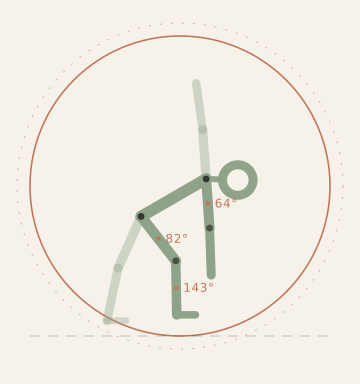
The angles are measured on the drawn skeleton and change with the variant you pick. Treat them as a starting reference, not a target to force.
Specification
| Sanskrit | Trikoṇāsana |
|---|---|
| Also called | Extended triangle |
| Level | Beginner |
| Loads | Hamstrings · Side body · Hips · Ankles |
| Props | Mat · Block |
| Typical hold | 30 sec |
| Gaze | |
| Published | 5 September 2026 · By The Asana Desk |
Getting in
- 01
Step the feet about a leg's length apart, front foot turned out ninety degrees and back foot turned in slightly.
- 02
Turn the pelvis to face the long edge of the mat and keep both hip points level as you bend.
- 03
Inhale, reach the arms out to the sides at shoulder height, and lengthen both sides of the waist.
- 04
Exhale and tip the torso sideways over the front leg from the hip crease, not from the waist.
- 05
Rest the bottom hand on the shin, the ankle or a block — resting, not reaching. Reach the top arm straight up.
- 06
Keep both sides of the waist long and both hip points facing the same direction.
- 07
Hold for 30 seconds, then press through the feet to come up on an inhale and change sides.
Working notes
The stack, and why it hangs on the hips
| Support for the bottom hand | What it does |
|---|---|
| Block at its highest setting | Keeps the waist long and the chest open — the best default |
| Block at its lowest setting | A middle step as the hamstrings lengthen |
| The shin | Deepens the pose; check that the lower back is still long |
| The floor beside the front foot | Available only with long hamstrings and open hips |
| The top of the thigh | A useful half-way house for stiff hamstrings |
The shape is a stack: the front foot, the front knee, the front hip, the shoulder, the top arm. If the pelvis tips forward as the torso goes down, the stack shears and the lower back takes the sideways bend instead of the hips and waist.
That is why the instruction is to bend from the hip crease. The hip joint can abduct freely; the lumbar spine can only side-bend about twenty degrees before the discs start to be loaded unevenly. Bending from the waist looks like a deeper triangle and is a worse one.
The head, and why it is not the point
Turning the gaze up to the top hand is the last thing to add, not the first. If the neck has any history, keep the head level and look straight ahead; the pose loses nothing in the legs, waist or hips, which is where the work is.
If you do turn the head up, turn it last and turn it slowly. The cervical spine is at the end of a long lever and it is the part of this pose that people most often regret the next morning.
Self-checks
- Are both hip points stacked, or has the top hip rolled forward?
- Is the top shoulder directly above the bottom one, or ahead of it?
- Is the bottom hand resting, or is the arm carrying the torso's weight?
- Is the back foot's outer edge still on the floor?
Safety
Skip or heavily modify the pose if any of these apply to you. When in doubt, ask a teacher who can see you move, or a clinician who knows your history.
- Acute lower back pain or a recent disc issue: avoid the sideways bend and hold the wide stance with the arms out instead.
- Neck injury or a history of cervical problems: keep the head level and the gaze forward, never turning up.
- Low blood pressure: come up slowly and in stages — this pose puts the head below the heart in the deepest version.
- Hamstring tear or recent strain: keep the front knee bent and the bottom hand high on a block.
- Inner knee pain in the front leg: shorten the stance and turn the front foot out less.
This page is informational only. It is not medical advice and no pose here is a treatment for any condition.
- Block under the bottom hand at its highest setting — the standard setup, not a beginner's concession.
- Shorten the stance if the front knee feels twisted or the hamstring is at its limit.
- Back heel to a wall to give the back foot something to press against.
- No sideways bend at all for a few sessions: just stand in the wide stance and reach the arms, to learn where the legs go.
Useful propsMat · Block
- A block is part of the pose here, not a workaround; most people will use it for years.
- A wall behind the back foot is the quickest fix for a back foot that keeps rolling onto its inner edge.
- Skip the block only when the bottom hand reaches the shin without the waist shortening.
- Acute lower back pain or a recent disc issue: avoid the sideways bend and hold the wide stance with the arms out instead.
- Neck injury or a history of cervical problems: keep the head level and the gaze forward, never turning up.
- Low blood pressure: come up slowly and in stages — this pose puts the head below the heart in the deepest version.
- Hamstring tear or recent strain: keep the front knee bent and the bottom hand high on a block.
- Inner knee pain in the front leg: shorten the stance and turn the front foot out less.
Inhale to lengthen both sides of the waist, exhale to tip sideways. Then steady nasal breathing for the hold.
- Use the exhale to go lower, never the inhale — the inhale lengthens, the exhale makes space.
- If the breath catches at the bottom of the bend, the waist has shortened; come up a little.
- Keep the breath audible only to yourself; if a partner can hear it across the room, you are forcing it.