Sequence · 25 min
Twenty-Five Minutes for Hamstring Length
A practice built entirely around one question: can the pelvis rotate forward over the thigh bones without the spine curling to help? Every pose here is chosen to make that question unavoidable, and every one has a prop that lets you answer it honestly.

- 01
 Mountain PoseTāḍāsanaStand tall and notice whether the knees are locked hard.
- 02
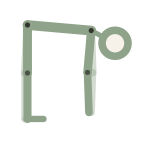 Standing Forward FoldUttānāsanaBend the knees generously and let the spine hang long. This is not the hamstring pose.
- 03
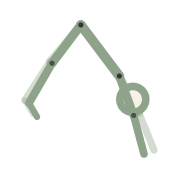 Downward-Facing DogAdho Mukha ŚvānāsanaBend the knees as much as the lower back needs, and pedal the heels.
- 04
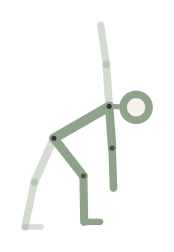 Triangle PoseTrikoṇāsanaLeft leg forward, bottom hand on a block so the waist stays long.
- 05Triangle PoseTrikoṇāsanaChange sides. The block height is not a measure of anything.
- 06
 Head-to-Knee PoseJānu ŚīrṣāsanaLeft leg long, strap around the sole, fold from the hip and not from the waist.
- 07Head-to-Knee PoseJānu ŚīrṣāsanaChange sides. Keep the folded knee supported.
- 08
 Seated Forward FoldPaścimottānāsanaBoth legs long, strap around both soles, spine long before it is low.
- 09
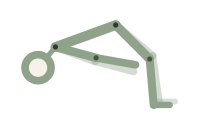 Bridge PoseSetu BandhāsanaBlock under the sacrum. Counterpose: the front of the hips has been closed all practice.
- 10
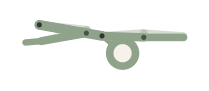 Child's PoseBālāsanaKnees wide, hips back toward the heels.
- 11
 Corpse PoseŚavāsanaThree minutes, legs heavy, no blanket needed if the room is warm.
The two things that stop hamstrings lengthening
| Pose | The prop | What it removes |
|---|---|---|
| Standing forward fold | Bent knees | The lower back's share of the fold |
| Downward dog | Bent knees | The same, plus the calf restriction |
| Triangle | Block under the bottom hand | The reach, so the waist stays long |
| Head to knee | Strap around the sole | The reach and the rounded back that follows it |
| Seated forward fold | Strap and a blanket | Both the reach and the tipped-back pelvis |
The first is a rounded spine: the fold happens above the hips and the hamstrings are never asked to lengthen at all. The second is a locked standing knee in the standing poses, which shifts the load into the joint and the calf rather than the muscle belly.
Both have the same solution and it sounds like a contradiction: bend the knees more. In the standing fold, bending the knees transfers the fold to the hips. In the seated folds, a strap does the same thing by removing the need to reach.
How long, and how often
Hamstring length responds to frequency much more than to intensity. Three sessions of this practice a week at sixty percent effort will change the pose more in a month than one hard session a week at ninety percent.
The seated folds in the middle hold for ten to twelve breaths, which is roughly a minute. That is long enough for the muscle to let go and short enough not to provoke the protective response that ends a hold early.
This sequence is informational only, not medical advice, and not a substitute for a teacher who can see you move. Skip any step that hurts, and check with a clinician about injuries, pregnancy or recent surgery.