Appears in
- 15'Fifteen-Minute Sunrise Mobility
- 15'Fifteen-Minute Wind-Down for Sleep
- 20'Sun Salutation A, Walked Through Slowly
- 20'Twenty-Minute Chair-Supported Gentle Practice
Pairs with
Pose · U
Standing Forward Fold
Uttānāsana
A fold that is mostly about the hips, not the back. The hamstrings set the limit for most people, and the spine gets blamed for it. Forty seconds with the knees slightly bent tells you which of the two is holding you up.
The shape, with joint angles
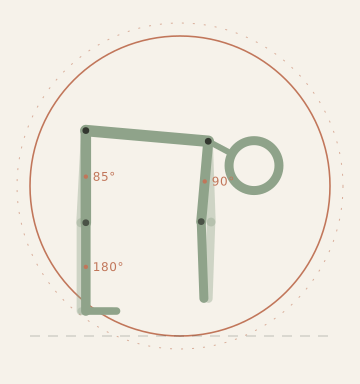
The angles are measured on the drawn skeleton and change with the variant you pick. Treat them as a starting reference, not a target to force.
Specification
| Sanskrit | Uttānāsana |
|---|---|
| Also called | Uttanasana |
| Level | Beginner |
| Loads | Hamstrings · Calves · Lower back · Spine |
| Props | Mat · Block · Strap |
| Typical hold | 40 sec |
| Gaze | |
| Published | 18 August 2026 · By The Asana Desk |
Getting in
- 01
Start in Mountain pose, feet hip-width apart and parallel.
- 02
Bend the knees enough to feel the belly rest against the thighs — usually about 20 to 30 degrees of knee bend.
- 03
Hinge from the hip creases and tip the pelvis forward, keeping the spine long rather than rounding immediately.
- 04
Let the hands come to the floor, to blocks, or to the shins; wherever they land without pulling the back into a curve.
- 05
Draw the shoulder blades down the back so the neck is not carrying the weight of the head.
- 06
Stay 30 to 40 seconds with the knees bent, then straighten them gradually over several breaths — no bouncing.
- 07
To come up, bend the knees, plant the feet, and roll up through a long spine, head last.
Working notes
Hamstrings or spine?
| Test | What it means | What to do |
|---|---|---|
| Fold deepens when knees bend | Hamstrings are the limit | Keep knees bent, fold daily for 4–6 weeks |
| Fold unchanged when knees bend | Restriction is spinal or in the hip capsule | Work on thoracic extension and hip rotation |
| Lower back aches after 10 seconds | You are rounding the lumbar spine too early | Hinge at the hips first, fold later |
Roughly four out of five people who cannot reach the floor in this pose are limited by hamstring length, not by a stiff back. The test is simple: bend the knees 30 degrees and fold again. If the fold gets noticeably deeper, the hamstrings were the brake. If nothing changes, the restriction is higher up the chain.
The other variable is the pelvis. Folding from the hip creases instead of the waist moves about 15 degrees of range from the lumbar spine to the hip joint, which is where it belongs.
Why the bounce does not work
Bouncing into a forward fold triggers a stretch reflex that makes the muscle contract against you for a second or two after each bounce. The result is a pose that feels intense and produces almost no lasting change. Thirty to forty seconds of steady, tolerable stretch does more than two minutes of bouncing.
The same goes for coming up. Standing up fast from a fold drops blood pressure in the head for a moment; rolling up over three or four breaths keeps most people from seeing stars.
Self-checks
- Are the knees bent enough that the belly meets the thighs?
- Is the weight in the middle of the foot rather than the toes?
- Can you take a full breath in without the back rounding further?
Safety
Skip or heavily modify the pose if any of these apply to you. When in doubt, ask a teacher who can see you move, or a clinician who knows your history.
- Glaucoma or very high eye pressure: avoid long inverted head positions.
- Recent retinal surgery or detached retina: skip the pose entirely and ask your ophthalmologist.
- Acute lower back pain or a herniated disc in a flare-up: keep the fold shallow, hands on blocks, spine long.
- Osteoporosis with a history of vertebral fracture: fold only with a fully lengthened spine and keep the hands high.
- Low blood pressure or a history of fainting when standing up.
This page is informational only. It is not medical advice and no pose here is a treatment for any condition.
- Hands on blocks at the highest setting to remove any pull on the lower back.
- Seated fold instead, if standing folds provoke dizziness.
- Back against a wall, sliding the hips back as you fold, to keep the weight over the heels.
- Arms clasped behind the back and lifted, to open the chest as you fold.
Useful propsMat · Block · Strap
- Two blocks under the hands change this from a hamstring stretch into a rest.
- A strap around the feet holds the hands in place if the floor is out of reach today.
- Folding a blanket under the balls of the feet lifts the front of the foot if the calves complain.
- Glaucoma or very high eye pressure: avoid long inverted head positions.
- Recent retinal surgery or detached retina: skip the pose entirely and ask your ophthalmologist.
- Acute lower back pain or a herniated disc in a flare-up: keep the fold shallow, hands on blocks, spine long.
- Osteoporosis with a history of vertebral fracture: fold only with a fully lengthened spine and keep the hands high.
- Low blood pressure or a history of fainting when standing up.
Breathe into the back of the ribs, five breaths minimum, letting the exhale do the folding rather than the arms pulling.
- If you cannot breathe into the back, the fold is too deep for today.
- Exhaling as you hinge gives the abdomen somewhere to go.
- Coming up, inhale halfway, pause, then finish on an exhale.