Appears in
- 15'Fifteen-Minute Sunrise Mobility
- 15'Fifteen-Minute Wind-Down for Sleep
- 20'Sun Salutation A, Walked Through Slowly
- 20'Twenty-Minute Chair-Supported Gentle Practice
Pairs with
Pose · B
Child's Pose
Bālāsana
The resting shape that most classes treat as a pause and most practitioners treat as a stretch. Ninety seconds here, with the forehead supported and the back ribs free to move, resets the breathing rate more reliably than any instruction to relax.
The shape, with joint angles
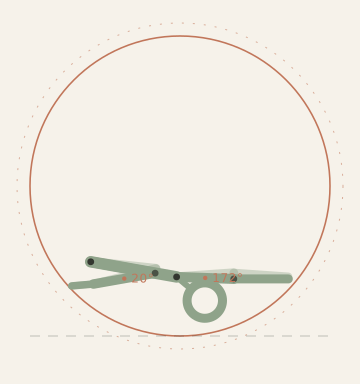
The angles are measured on the drawn skeleton and change with the variant you pick. Treat them as a starting reference, not a target to force.
Specification
| Sanskrit | Bālāsana |
|---|---|
| Also called | Balasana |
| Level | Beginner |
| Loads | Lower back · Hips · Shoulders · Neck |
| Props | Mat · Bolster · Blanket · Block |
| Typical hold | 1 min 30 sec |
| Gaze | |
| Published | 23 August 2026 · By The Asana Desk |
Getting in
- 01
Kneel with the big toes touching and the knees apart — wide enough that the belly can drop between the thighs.
- 02
Sit the hips back toward the heels; if the heels do not reach the buttocks, place a folded blanket in the gap.
- 03
Walk the hands forward and lower the torso between the thighs.
- 04
Rest the forehead on the mat, on a block, or on stacked fists. The head should have something to land on.
- 05
Let the arms stay where they landed, or stretch them forward; either is correct.
- 06
Stay for 60 to 90 seconds, letting the back of the ribs widen with each inhale.
- 07
To come out, walk the hands back, lift the torso with an inhale, and sit up slowly.
Working notes
Why the forehead needs support
| Setup | Best for | What changes |
|---|---|---|
| Knees wide, hips to heels | Most people, tight hips | Belly has room; groins stay comfortable |
| Knees together, hips high on a bolster | Tight ankles or knees | Less knee flexion; more length in the spine |
| Forehead on a block | Stiff neck or a big chest | The neck stays relaxed; the breath slows |
| Arms alongside the body | Shoulder pain | No overhead reach; the shoulders can drop |
The forehead resting on something is not a comfort detail — it triggers a mild, well-documented calming response that lowers heart rate and slows breathing within about thirty seconds. Held with the head hanging unsupported, the same pose keeps the neck muscles working and the calming effect is much smaller.
This is why a block, a bolster or even stacked fists under the forehead changes the quality of the pose more than any adjustment to the hips.
The pose people leave too early
Child's Pose is usually held for eight or ten breaths in a class, which is long enough to notice you are tired and not long enough for the breathing rate to actually drop. Ninety seconds is where the measurable change happens for most people: roughly four to six breaths per minute slower than at the start.
If the knees hurt, the pain is almost always from the hips not going back far enough — the flexion is happening at the knee rather than the hip. Put a blanket behind the knees or between the calves and the thighs and the sensation usually disappears.
Self-checks
- Can you breathe into the back of the ribs without the shoulders moving?
- Is the forehead resting on something rather than hovering?
- Are the knees comfortable rather than pinched?
Safety
Skip or heavily modify the pose if any of these apply to you. When in doubt, ask a teacher who can see you move, or a clinician who knows your history.
- Knee injury, recent knee surgery or a torn meniscus: use the chair version instead of kneeling.
- Pregnancy after the first trimester: keep the knees very wide and the torso supported high on a bolster.
- Recent ankle or foot surgery: place a rolled blanket under the shins so the ankles are not fully pointed.
- Acute neck pain: use a higher block so the head is not below the shoulders.
This page is informational only. It is not medical advice and no pose here is a treatment for any condition.
- A bolster or stacked blankets lengthwise under the torso for a fully supported version.
- Knees together and hips on a block, if the knees are sensitive.
- Side-lying child's pose (one arm forward, torso turned) if the chest feels compressed.
- Sitting on a chair and folding forward, if kneeling is not available at all.
Useful propsMat · Bolster · Blanket · Block
- A bolster under the torso makes this a passive rest rather than a stretch.
- A blanket in the gap between the hips and the heels removes the knee strain.
- A block under the forehead keeps the neck neutral and reliably slows the breath.
- Knee injury, recent knee surgery or a torn meniscus: use the chair version instead of kneeling.
- Pregnancy after the first trimester: keep the knees very wide and the torso supported high on a bolster.
- Recent ankle or foot surgery: place a rolled blanket under the shins so the ankles are not fully pointed.
- Acute neck pain: use a higher block so the head is not below the shoulders.
Breathe into the back of the body, four counts in and six counts out, for at least ten breaths.
- The back of the ribs should widen rather than the chest pressing into the thighs.
- If the exhale is longer than the inhale and comfortable, the nervous system is responding.
- Counting the breaths makes ninety seconds feel like ninety seconds rather than five minutes.