Appears in
- 15'Fifteen-Minute Sunrise Mobility
- 15'Fifteen-Minute Wind-Down for Sleep
- 20'Sun Salutation A, Walked Through Slowly
- 20'Twenty-Minute Chair-Supported Gentle Practice
Pairs with
Pose · S
Corpse Pose
Śavāsana
Five minutes of lying still, which sounds like nothing and is the hardest thing in the practice for most people. It is also the only pose where the point is entirely what happens in the nervous system rather than in the muscles.
The shape, with joint angles
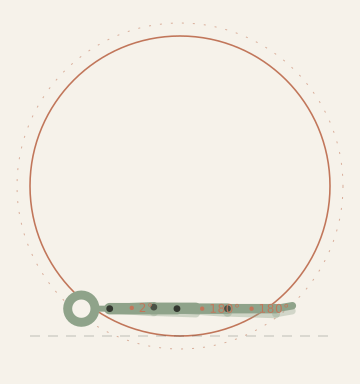
The angles are measured on the drawn skeleton and change with the variant you pick. Treat them as a starting reference, not a target to force.
Specification
| Sanskrit | Śavāsana |
|---|---|
| Also called | Savasana, Final Rest |
| Level | Beginner |
| Loads | Back · Neck · Hips · Spine |
| Props | Mat · Blanket · Bolster · Block |
| Typical hold | 5 min |
| Gaze | |
| Published | 3 September 2026 · By The Asana Desk |
Getting in
- 01
Lie on your back with the legs comfortably apart and the feet falling open.
- 02
Let the arms rest away from the body, palms up, with the shoulders relaxed toward the floor.
- 03
Tuck the chin very slightly so the back of the neck is long, then let the head rest heavily.
- 04
Scan from the feet upward and deliberately soften the jaw, the tongue, the eyes and the space between the eyebrows.
- 05
Stay for at least five minutes. Set a timer so you are not checking the clock.
- 06
To finish, roll to one side, pause for three breaths, then press up to sitting with a long spine.
Working notes
Why it is the hardest pose
| Common discomfort | Cause | Fix |
|---|---|---|
| Lower back aches | The lumbar curve is flattened by straight legs | Bend the knees over a bolster, or put a rolled blanket under the knees |
| Neck aches | The head is tilted back by a thick mat or a lifted chin | A thin folded blanket under the head, chin slightly down |
| Cold | Body temperature drops when the muscles stop working | A blanket over the body; this is the most useful prop on the list |
| Mind will not settle | Normal | Count ten exhales, then start again at one |
Lying still removes every external task, which leaves the mind with nothing to do but produce its own. Most people discover within forty seconds that they are rehearsing a conversation or planning tomorrow. That is not a failure of the pose — noticing it and returning to the body is precisely the practice.
Five minutes is not arbitrary. Heart rate, breathing rate and blood pressure continue to fall for the first several minutes of stillness; leaving at two minutes means stopping before most of the effect arrives.
Finishing properly
Sitting up quickly from five minutes of stillness is the same mistake as standing up quickly from a forward fold: blood pressure has dropped and the head has not caught up. Rolling to the side and pausing for three breaths gives the circulation a chance to adjust, and it also marks the end of the practice as a deliberate act rather than a scramble for the phone.
If you only have ten minutes for a practice, five minutes of movement and five minutes here is a better use of the time than ten minutes of movement.
Self-checks
- Is the lower back comfortable rather than compressed?
- Is the jaw actually slack, or just closed?
- Have you stopped checking the clock?
Safety
Skip or heavily modify the pose if any of these apply to you. When in doubt, ask a teacher who can see you move, or a clinician who knows your history.
- Low blood pressure: sit up slowly, and consider a seated rest instead.
- Acute lower back pain: use the knees-bent version; lying flat may aggravate it.
- Pregnancy after the first trimester: lie on the left side with a pillow between the knees.
- Recent eye surgery: check with your surgeon about lying flat with the eyes closed for long periods.
- A history of dissociation or panic: keep the eyes open and the room well lit, and shorten the hold.
This page is informational only. It is not medical advice and no pose here is a treatment for any condition.
- Knees bent over a bolster, or a rolled blanket under the knees, for lower back comfort.
- A folded blanket under the head if the chin tilts up.
- Legs up the wall instead, if lying flat leaves the lower back uneasy.
- Seated rest in a chair with the spine supported, if lying down is not comfortable today.
Useful propsMat · Blanket · Bolster · Block
- A blanket over the body is the single most useful prop here — the body cools quickly once it stops moving.
- A bolster under the knees removes the lower back arch for people with a strong lumbar curve.
- An eye bag or a folded cloth over the eyes helps people who find it hard to keep the eyes closed.
- A timer set to a gentle sound means you can stop tracking the minutes.
- Low blood pressure: sit up slowly, and consider a seated rest instead.
- Acute lower back pain: use the knees-bent version; lying flat may aggravate it.
- Pregnancy after the first trimester: lie on the left side with a pillow between the knees.
- Recent eye surgery: check with your surgeon about lying flat with the eyes closed for long periods.
- A history of dissociation or panic: keep the eyes open and the room well lit, and shorten the hold.
Let the breath find its own rhythm; do not count it for the first minute, then count ten slow exhales and begin again.
- Letting the exhale be longer than the inhale is what lowers the heart rate.
- If you cannot feel the breath at all, put a hand on the abdomen for a minute.
- Snoring is a sign the body needed the rest, not a failure to meditate.