Appears in
- 15'Fifteen-Minute Sunrise Mobility
- 15'Fifteen-Minute Wind-Down for Sleep
- 20'Sun Salutation A, Walked Through Slowly
- 20'Twenty-Minute Chair-Supported Gentle Practice
Pairs with
Pose · T
Mountain Pose
Tāḍāsana
Standing still, deliberately. Mountain pose is the reference shape every other standing pose is measured against, and it is the one most people skip. Forty-five seconds of honest stacking tells you more about your balance than a minute of wobbling in Tree.
The shape, with joint angles
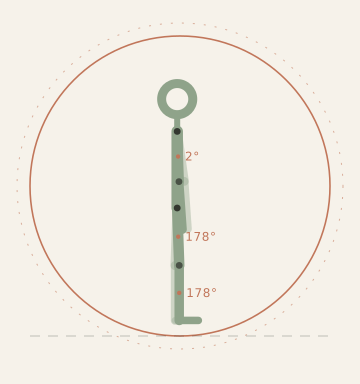
The angles are measured on the drawn skeleton and change with the variant you pick. Treat them as a starting reference, not a target to force.
Specification
| Sanskrit | Tāḍāsana |
|---|---|
| Also called | Samasthiti |
| Level | Beginner |
| Loads | Ankles · Spine · Shoulders · Balance |
| Props | Mat · Wall |
| Typical hold | 45 sec |
| Gaze | |
| Published | 16 August 2026 · By The Asana Desk |
Getting in
- 01
Stand with the feet hip-width apart, outer edges of the feet parallel, weight spread evenly across the ball, the outer edge and the heel of each foot.
- 02
Lift the toes for a second, feel the three contact points, then lay the toes back down without letting the weight slide forward.
- 03
Draw the front of the thighs back very slightly so the kneecaps lift — about a centimetre of movement, no more.
- 04
Lengthen the tailbone toward the floor and let the ribcage settle; the lower ribs move back, not the chest forward.
- 05
Roll the upper arms outward, then let the arms hang so the palms face the thighs and the fingertips point down.
- 06
Lengthen the back of the neck and let the chin rest level. The crown of the head is the highest point of the body.
- 07
Breathe for 45 to 60 seconds, then step out of the pose by softening the knees first.
Working notes
What the pose is actually training
| Segment | Typical angle | What it should feel like |
|---|---|---|
| Ankle | about 90° | Flat, quiet, no gripping in the toes |
| Knee | near 180°, not locked | Soft, with the kneecap lifted by the thigh |
| Hip | about 180° | Level, neither tucked hard nor pushed forward |
| Shoulder | about 180° (arms down) | Wide across the collarbones, arms heavy |
Nothing moves, so everything has to work quietly. The muscles along the spine hold the trunk upright against gravity, the ankles make micro-adjustments several times per second, and the feet report the ground back to the brain. That feedback loop is the point: the pose is a calibration, not a stretch.
Because the shape is neutral, it is also the best place to notice what is not neutral. A shoulder that sits higher, a hip that turns out, a heel that will not take weight — all of it is obvious here and invisible in a lunge.
Where it usually goes wrong
The most common fault is standing on the balls of the feet with the toes gripping: it feels active, but it moves the weight forward of the ankle and the whole body starts to lean. The second is over-tucking the pelvis to look 'straight' — that flattens the lower back and usually comes with the ribs flaring at the front.
The third is the breath. People hold it. If you can hear yourself breathing in Mountain pose, you are gripping somewhere you do not need to.
Self-checks
- Can you lift one toe at a time without the weight shifting?
- Is the space between the lower ribs and the front of the pelvis the same on both sides?
- After 45 seconds, are you breathing at the same rate you started with?
Safety
Skip or heavily modify the pose if any of these apply to you. When in doubt, ask a teacher who can see you move, or a clinician who knows your history.
- Low blood pressure or a tendency to faint: standing still can pool blood in the legs; keep the feet moving slightly or hold a wall.
- Acute vertigo or an inner-ear flare-up: keep the eyes open and the stance wider.
- Recent ankle sprain or foot surgery: keep weight on both feet and use a wall for support.
- If standing unsupported causes pain anywhere in the feet, stop and sit down rather than pushing through it.
This page is informational only. It is not medical advice and no pose here is a treatment for any condition.
- Heels against a wall with the tailbone touching lightly, to feel the vertical line.
- Feet together rather than hip-width, if the inner ankles tend to roll in.
- Standing on a folded mat or blanket if the floor is cold or very hard.
- Eyes closed for 15 seconds at a time to increase the balance demand.
Useful propsMat · Wall
- A wall behind you is the cheapest feedback device there is: touch it with the shoulder blades, not the lower back.
- A block between the upper thighs gives the inner legs something to hug if the stance feels vague.
- No prop at all is also a valid answer once the shape is familiar.
- Low blood pressure or a tendency to faint: standing still can pool blood in the legs; keep the feet moving slightly or hold a wall.
- Acute vertigo or an inner-ear flare-up: keep the eyes open and the stance wider.
- Recent ankle sprain or foot surgery: keep weight on both feet and use a wall for support.
- If standing unsupported causes pain anywhere in the feet, stop and sit down rather than pushing through it.
Breathe through the nose, evenly, with the exhale a beat longer than the inhale — roughly four counts in, six counts out.
- Count the breaths instead of the seconds if you tend to hold your breath.
- If the exhale snags, the ribs are too far forward; settle them back and try again.
- Keep the jaw and the tongue soft; a clenched jaw shows up first in the breath.