Sequence · 20 min
Twenty-Minute Runner's Recovery
A practice for the day after a long run, when the calves are tight, the hip flexors are shorter than they were last week and everything wants to be stretched at once. The order moves from the calves upward, because that is the order in which the restriction actually runs.

- 01
 Mountain PoseTāḍāsanaStand and feel which calf is still tight from the last run.
- 02
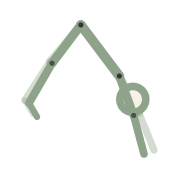 Downward-Facing DogAdho Mukha ŚvānāsanaBend the knees, lift the heels, and pedal slowly — the calves get their turn here.
- 03
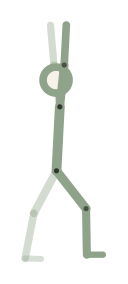 Crescent LungeAñjaneyāsanaLeft foot back, right knee bent, hips pressing forward and down.
- 04Crescent LungeAñjaneyāsanaChange sides. Keep the back leg active rather than hanging.
- 05
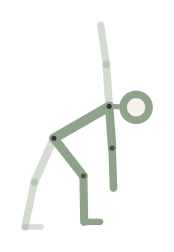 Triangle PoseTrikoṇāsanaLeft foot forward, block under the bottom hand, both sides of the waist long.
- 06Triangle PoseTrikoṇāsanaChange sides, resting rather than reaching with the bottom hand.
- 07
 Revolved Triangle PoseParivṛtta TrikoṇāsanaLeft foot forward, right hand to a block outside it, left arm up. Turn first, then fold.
- 08Revolved Triangle PoseParivṛtta TrikoṇāsanaChange sides. Shorten the stance if the hips cannot stay level.
- 09
 Half Moon PoseArdha CandrāsanaFrom triangle, shift onto the left leg and stack the hip over the ankle.
- 10Half Moon PoseArdha CandrāsanaChange sides. Use the wall if the balance has gone.
- 11
 Seated Forward FoldPaścimottānāsanaBoth legs long, strap around the soles, fold from the hip rather than the waist.
- 12
 Corpse PoseŚavāsanaThree minutes, legs slightly apart, everything heavy.
Calves first, and why
| Pose | What it is for | If it is too much |
|---|---|---|
| Downward dog, knees bent | Calves and the whole back line | Hands on a wall or a chair |
| Crescent lunge | Hip flexors and quadriceps | Back knee down on a blanket |
| Triangle | Hamstrings and the outer hip | Block under the bottom hand |
| Revolved triangle | The same, with rotation added | Shorten the stance considerably |
| Half moon | The outer hip and the balance | Back to a wall |
| Seated forward fold | Hamstrings, symmetrically | Strap and a blanket |
A tight calf limits how far the ankle can bend, and an ankle that will not bend forces the knee and the hip to work around it. Opening the calf first means every pose after it gets a little more range for free.
The pedalling in Downward Dog is doing that job. Twenty slow alternating heel presses, with the knees bent, moves more in the calf than a long static hold and does not leave the ankle sore for the next run.
The day after is not the day to go deep
Muscles that are still repairing from a long run respond better to movement than to deep stretching. The holds in this sequence are short on purpose: five to ten breaths, at about sixty percent of the available range.
If something feels like a strain rather than a stretch — a pulling sensation in one specific spot rather than a broad length — stop that pose and move to the next one. Recovery practices are supposed to be boring; the poses that feel dramatic the day after a run are usually the ones doing damage.
This sequence is informational only, not medical advice, and not a substitute for a teacher who can see you move. Skip any step that hurts, and check with a clinician about injuries, pregnancy or recent surgery.