Pose · A
Crescent Lunge
Añjaneyāsana
A long stance with the back heel lifted and the arms overhead. This page covers the standing version — the back knee stays off the floor — because it is the version that teaches the two things the pose is for: keeping the back leg active while the front hip opens, and stacking the torso over the pelvis instead of tipping it forward.
The shape, with joint angles
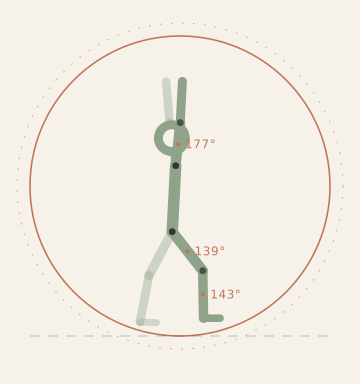
The angles are measured on the drawn skeleton and change with the variant you pick. Treat them as a starting reference, not a target to force.
Specification
| Sanskrit | Añjaneyāsana |
|---|---|
| Also called | Anjaneyasana, high lunge |
| Level | Beginner |
| Loads | Quadriceps · Hips · Chest · Balance |
| Props | Mat · Block · Wall |
| Typical hold | 30 sec |
| Gaze | |
| Published | 23 September 2026 · By The Asana Desk |
Getting in
- 01
From a standing forward fold, step the left foot back about a leg's length and come up onto the ball of the left foot.
- 02
Bend the right knee until it sits roughly above the right ankle, and keep the right knee pointing forward.
- 03
Press the left heel backwards and up, so the back leg is straight and active rather than hanging.
- 04
Bring both hip points level and forward; the back hip wants to turn out, so keep it square.
- 05
Inhale the arms overhead, alongside the ears, and lengthen the tailbone down.
- 06
Lean back very slightly — a few degrees — so the front of the left hip lengthens, without letting the ribs flare.
- 07
Hold for 30 seconds, then step the left foot forward and repeat on the other side.
Working notes
The two versions, and why this page teaches the standing one
| Version | Back leg | Best for |
|---|---|---|
| Standing (this page) | Straight, heel lifted, quadriceps active | Learning the setup and the hip position |
| Kneeling | Knee down, shin on the mat | Long holds and hip-flexor work after a day of sitting |
| Back knee on a blanket | Knee down with padding | Tender knees, same shape as kneeling |
| Hands on blocks, knee down | Knee down, torso upright | When the shoulders cannot hold the arms overhead |
The kneeling version — back knee on the mat — is the one in most classes, and it is a fine pose. It is also much more forgiving: with the knee down, the pelvis has somewhere to rest and almost any torso position will hold together.
The standing version has no such support, so every fault shows up. If the back leg is passive, the balance goes. If the hips are uneven, the front knee twists. If the torso tips forward, the breath shortens. Learn it standing and the kneeling version becomes a rest rather than a puzzle.
The back leg is doing the work
The most common version of this pose has the back leg doing nothing at all: the foot is up on the toes, the knee is soft and the leg hangs from the hip. The pose then becomes a one-legged squat with an increasingly unhappy front knee.
Press the back heel away from you and up, straighten the back knee fully, and squeeze the back leg's inner thigh toward its own centre line. That single action turns the pose from a balance test into a hip and quadriceps stretch, which is what it is for.
Self-checks
- Is the back knee straight, or quietly bent?
- Is the front knee over the front ankle, or well past the toes?
- Are both hip points facing forward, or has the back hip opened out?
- Is the tailbone lengthening down, or has the lower back arched to make the arms look higher?
Safety
Skip or heavily modify the pose if any of these apply to you. When in doubt, ask a teacher who can see you move, or a clinician who knows your history.
- Acute knee pain: keep the front knee bend shallow and the stance short, and skip the kneeling version.
- Lower back pain that increases as the arms lift: keep the arms forward instead of overhead.
- Recent ankle injury on the back foot: keep the back heel down and the stance shorter.
- Shoulder injury: keep the hands on the hips or on blocks.
- High blood pressure: arms at shoulder height rather than overhead.
This page is informational only. It is not medical advice and no pose here is a treatment for any condition.
- Back knee down on a folded blanket for the kneeling version; keep the same arm and torso work.
- Hands on blocks in front of you if the shoulders tire before the legs do.
- Back heel against a wall to teach the back leg what 'pressing back' means.
- Shorten the stance if the front knee complains — the front knee should never be the limiting factor.
Useful propsMat · Block · Wall
- A folded blanket under the back knee turns this into a long-hold hip opener you can actually stay in.
- Two blocks under the hands let a tired upper body keep the shape.
- A wall in front of the back foot is the clearest feedback for whether the back leg is pressing back at all.
- Acute knee pain: keep the front knee bend shallow and the stance short, and skip the kneeling version.
- Lower back pain that increases as the arms lift: keep the arms forward instead of overhead.
- Recent ankle injury on the back foot: keep the back heel down and the stance shorter.
- Shoulder injury: keep the hands on the hips or on blocks.
- High blood pressure: arms at shoulder height rather than overhead.
Inhale to step back and lift the arms, exhale to settle into the lunge; then steady even breathing.
- If the breath shortens when the arms go up, the ribs have flared; draw them back and try again.
- Use the exhale to sink the hips a centimetre lower.
- Lengthen the exhale if the balance feels fragile — it slows the whole system down.