Pairs with
Pose · M
Cat and Cow
Mārjāryāsana / Bitilāsana
Two poses that are taught as one, alternating with the breath. On all fours, the spine rounds and then arches, and the whole point is that the movement comes from the spine rather than from the arms, the hips or the neck.
The shape, with joint angles
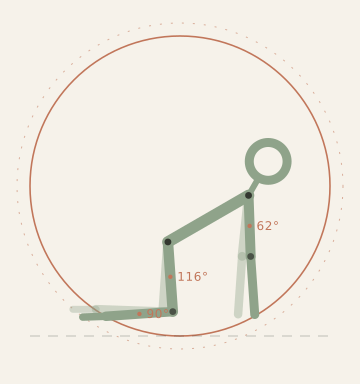
The angles are measured on the drawn skeleton and change with the variant you pick. Treat them as a starting reference, not a target to force.
Specification
| Sanskrit | Mārjāryāsana / Bitilāsana |
|---|---|
| Also called | Marjaryasana and Bitilasana |
| Level | Beginner |
| Loads | Spine · Lower back · Core · Wrists |
| Props | Mat · Blanket |
| Typical hold | 1 min |
| Gaze | |
| Published | 21 September 2026 · By The Asana Desk |
Getting in
- 01
Come onto all fours with the wrists under the shoulders and the knees under the hips, shins and the tops of the feet on the mat.
- 02
Spread the fingers wide and press through the base of every finger so the wrists are not carrying the weight on their own.
- 03
Inhale into Cow: drop the belly, lift the chest and the tailbone, and take the gaze slightly forward and up.
- 04
Exhale into Cat: press the floor away, round the spine, tuck the tailbone and drop the gaze to the navel.
- 05
Keep the hips over the knees and the shoulders over the wrists throughout — the body does not slide back and forth.
- 06
Move with the breath for eight to ten rounds, letting each round be slightly slower than the last.
- 07
Finish in a neutral spine, then sit back to Child's Pose.
Working notes
What the pair does that a single pose cannot
| Round | Breath | Spine | Gaze |
|---|---|---|---|
| Cow | Inhale | Extends — belly drops, chest lifts | Forward and slightly up |
| Cat | Exhale | Flexes — spine rounds, tailbone tucks | Down at the navel |
| Neutral | One quiet breath | Long and flat | Down at the floor |
Cat and Cow move the spine through flexion and extension in the one position where the spine has no load on it at all: the body is supported on four points and the back is free to move through its whole range. Very little else in a home practice does that.
The alternation is also the simplest place to learn to move with the breath. Because the movement is small and safe, the coordination can be practised slowly and then carried into every other pose.
Where the movement should not come from
The arms should not push the chest up and down. If the elbows bend and straighten during the round, the movement is coming from the arms, and the spine is being carried rather than moved.
The hips should not slide back toward the heels in Cat or forward in Cow. Keeping the hips over the knees is what keeps the movement in the spine; if the whole body rocks, the spine does almost nothing.
Self-checks
- Are the shoulders staying over the wrists and the hips over the knees?
- Are the elbows straight throughout the round?
- Is the neck following the spine rather than leading it?
- Can you feel the movement between the shoulder blades, not only in the lower back?
Safety
Skip or heavily modify the pose if any of these apply to you. When in doubt, ask a teacher who can see you move, or a clinician who knows your history.
- Acute wrist pain or carpal tunnel flare-up: take the forearms to the floor or do the seated version.
- Recent knee injury or knee replacement: pad heavily, or practise seated in a chair.
- Acute lower back pain: reduce the range dramatically and stop short of the end of either shape.
- Pregnancy: keep the knees wider than the hips and avoid pressing the belly down in Cow.
- Neck injury: keep the neck in line with the spine rather than lifting or dropping the head.
This page is informational only. It is not medical advice and no pose here is a treatment for any condition.
- A folded blanket under the knees, always, if the floor is hard or the knees are tender.
- Forearms down instead of the hands, if the wrists are sore.
- Seated version: hands on the thighs, moving the spine through the same two shapes in a chair.
- Smaller range: even a few centimetres of rounding and arching, done ten times with the breath, is the practice.
Useful propsMat · Blanket
- A blanket under the knees is the one prop that decides whether this pose is comfortable enough to do daily.
- A folded mat under the wrists is worth it if the practice is long and the floor is hard.
- No props needed once the knees are used to the floor.
- Acute wrist pain or carpal tunnel flare-up: take the forearms to the floor or do the seated version.
- Recent knee injury or knee replacement: pad heavily, or practise seated in a chair.
- Acute lower back pain: reduce the range dramatically and stop short of the end of either shape.
- Pregnancy: keep the knees wider than the hips and avoid pressing the belly down in Cow.
- Neck injury: keep the neck in line with the spine rather than lifting or dropping the head.
One breath per movement: inhale to Cow, exhale to Cat, with no pause between the two.
- Let the breath lead and the body follow — the movement starts on the first third of the inhale.
- If the breath and the movement have come apart, slow the movement down rather than speeding the breath up.
- Ten rounds is about a minute and a half of continuous movement, which is a complete warm-up.