Appears in
Pairs with
Pose · B
Cobra Pose
Bhujaṅgāsana
A backbend built by the spine, not by the hands. Cobra is the safest place to learn how much of the lift the back muscles can produce on their own — which is usually less than people expect and more than they use.
The shape, with joint angles
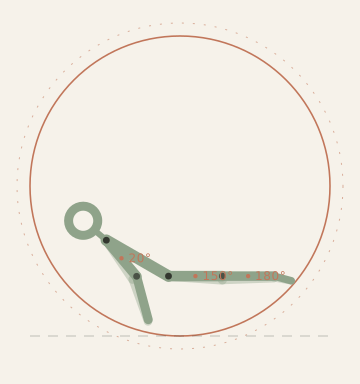
The angles are measured on the drawn skeleton and change with the variant you pick. Treat them as a starting reference, not a target to force.
Specification
| Sanskrit | Bhujaṅgāsana |
|---|---|
| Also called | Bhujangasana |
| Level | Beginner |
| Loads | Spine · Chest · Upper back · Lower back |
| Props | Mat · Blanket |
| Typical hold | 20 sec |
| Gaze | |
| Published | 30 August 2026 · By The Asana Desk |
Getting in
- 01
Lie face down with the legs hip-width apart, tops of the feet on the mat.
- 02
Place the hands under the shoulders, elbows bent and hugged in toward the ribs.
- 03
Press the pubic bone down and lengthen the tailbone toward the heels.
- 04
Inhale and peel the chest off the mat, using the back muscles first; the hands are there for guidance, not for pushing.
- 05
Stop lifting when the hands begin to carry real weight — that is your current edge.
- 06
Roll the upper arms outward so the collarbones widen, and keep the elbows slightly bent.
- 07
Hold for 15 to 20 seconds, then lower on an exhale with control, turning the head to one side to rest.
Working notes
Cobra and Upward Dog are not the same pose
| Cobra | Upward-Facing Dog | |
|---|---|---|
| Legs | On the floor, tops of feet down | Lifted, thighs off the floor |
| Arms | Bent, doing little | Straight, doing a lot |
| Shoulders | Over the elbows | Over the wrists, drawn back and down |
| Best for | Learning spinal extension | Strong practitioners with mobile shoulders |
Cobra keeps the thighs and the pubic bone on the floor and lifts only the chest; Upward-Facing Dog lifts the whole front body and balances on the hands and the tops of the feet. The first is a spinal extension, the second is an arm balance with a backbend in it. Choosing the wrong one for your shoulders or lower back is a common source of trouble.
A useful rule of thumb: if the hands are pushing hard enough that the arms straighten and the shoulders creep up toward the ears, you have drifted from Cobra into an Upward Dog that the shoulders may not be ready for.
Where the bend comes from
The thoracic spine — the part with the ribs attached — is where most of the useful extension lives, and the lumbar spine bends easily but complains later. In Cobra, aim to move the lift up between the shoulder blades rather than concentrating it at the waist. The cue that works for most people: lengthen first, then lift, then widen the collarbones.
If the lower back aches during the pose and not after, the bend is too low. If it aches the next morning, the pose was held too long or pushed too deep.
Self-checks
- Are the pubic bone and the tops of both thighs still on the mat?
- Are the shoulders away from the ears?
- Is the lift coming from the back muscles rather than the hands pushing?
Safety
Skip or heavily modify the pose if any of these apply to you. When in doubt, ask a teacher who can see you move, or a clinician who knows your history.
- Acute lower back pain or a disc injury in a flare-up: skip and work on core support first.
- Spondylolisthesis or a recent vertebral fracture: avoid backbends without medical clearance.
- Pregnancy: avoid lying on the abdomen after the first trimester.
- Recent abdominal surgery or hernia: avoid the abdominal stretch.
- Carpal tunnel syndrome: keep the hands light or rest them further forward.
This page is informational only. It is not medical advice and no pose here is a treatment for any condition.
- Hands further forward, elbows bent more, for a lower lift.
- Sphinx pose — forearms down, chest lifted — for a gentler and longer hold.
- A folded blanket under the hips if the lower back feels compressed.
- Cobra with the hands lifted entirely off the floor, to test how much the back can do alone.
Useful propsMat · Blanket
- A blanket under the hips changes the angle at the lumbar spine and often removes compression.
- A rolled towel under the front of the ankles makes the tops of the feet comfortable.
- Blocks under the hands allow a higher lift without pushing the shoulders up.
- Acute lower back pain or a disc injury in a flare-up: skip and work on core support first.
- Spondylolisthesis or a recent vertebral fracture: avoid backbends without medical clearance.
- Pregnancy: avoid lying on the abdomen after the first trimester.
- Recent abdominal surgery or hernia: avoid the abdominal stretch.
- Carpal tunnel syndrome: keep the hands light or rest them further forward.
Inhale to rise, hold the breath for no more than a second at the top, then breathe steadily for the hold and exhale to come down.
- Breathing into the back of the ribs while lifted is the goal; the chest does not need to expand forward.
- If the breath becomes shallow, lower a few centimetres.
- Exhale all the way down rather than dropping.