Appears in
Pairs with
Pose · C
Four-Limbed Staff Pose
Chaturaṅga Daṇḍāsana
The hardest fifteen seconds in a sun salutation, and the pose where shoulders get hurt most often. The elbows track back, not out, and the shoulders never drop below the height of the elbows.
The shape, with joint angles
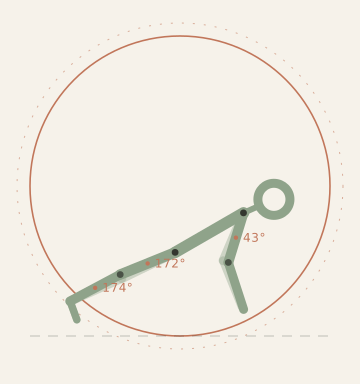
The angles are measured on the drawn skeleton and change with the variant you pick. Treat them as a starting reference, not a target to force.
Specification
| Sanskrit | Chaturaṅga Daṇḍāsana |
|---|---|
| Also called | Low Plank |
| Level | Intermediate |
| Loads | Arms · Core · Shoulders · Wrists |
| Props | Mat · Block · Strap |
| Typical hold | 15 sec |
| Gaze | |
| Published | 27 August 2026 · By The Asana Desk |
Getting in
- 01
Start in Plank pose with the shoulders directly over the wrists.
- 02
Shift forward about 5 cm so the shoulders come slightly past the wrists — this is the position the elbows need.
- 03
Bend the elbows and draw them back along the ribs, aiming them at the back of the mat rather than out to the sides.
- 04
Lower until the upper arms are parallel to the floor — roughly a 90-degree elbow — and stop there.
- 05
Keep the shoulders at or above elbow height; if they sink lower, the front of the joint is taking the load.
- 06
Hold for 10 to 15 seconds, or use the pose as a single movement on an exhale rather than a hold.
- 07
Exit forward into Upward-Facing Dog, or lower the knees and rest.
Working notes
The elbow is the whole pose
| Fault | What it loads | Quick fix |
|---|---|---|
| Elbows out to the sides | Front of the shoulder | Aim the elbows at the back edge of the mat |
| Shoulders below the elbows | Shoulder capsule, biceps tendon | Stop higher; strength arrives in weeks |
| Hips higher than the shoulders | Nothing much, but no pose either | Lower the hips to shoulder height first |
| Hands too far forward | Wrists | Bring the hands back under the shoulders |
When the elbows flare out to the sides, the upper arm rotates internally and the space under the acromion narrows — the tendons of the rotator cuff get pinched between bone surfaces. Done with the elbows tracking back, the same movement loads the triceps and chest with the joint in a far safer position.
The other common fault is going too deep. 'Chest and thighs parallel to the floor' is a description of the end range for a very strong practitioner, not a requirement. Stopping with the upper arms parallel to the floor is a complete pose.
Why it is worth learning slowly
Chaturanga appears eight or more times in a single vinyasa class, which means the shoulder carries this load dozens of times a week. Getting the alignment right is the difference between building arm strength and accumulating a shoulder problem over a year.
If you cannot yet lower with control, do not. Lower the knees first, then the chest. A four-limbed staff done from the knees with the elbows tracking back builds exactly the same strength and keeps the shoulders out of trouble.
Self-checks
- Are the elbows pointing back rather than out?
- Are the shoulders at or above elbow height?
- Is the lower back still flat rather than sagging?
Safety
Skip or heavily modify the pose if any of these apply to you. When in doubt, ask a teacher who can see you move, or a clinician who knows your history.
- Shoulder impingement, labral tear or rotator cuff injury: do not load this position without clearance.
- Wrist pain in extension: use blocks or use forearms in a different shape.
- Pregnancy: skip the deep version; keep the hands high on blocks.
- Elbow tendonitis: reduce the range and frequency rather than pushing through.
- Recent abdominal surgery: avoid the strong abdominal bracing this pose requires.
This page is informational only. It is not medical advice and no pose here is a treatment for any condition.
- Knees down, same elbow path — the standard beginner version.
- Hands on blocks, which shortens the range and keeps the shoulders higher.
- A strap around the upper arms at elbow width keeps them from flaring.
- Skip the hold and lower straight into Upward-Facing Dog or Cobra instead.
Useful propsMat · Block · Strap
- A strap looped around the upper arms just above the elbows is the classic fix for flaring.
- Blocks under the hands reduce the depth and let you practise the elbow path safely.
- A folded blanket under the knees makes the knee-down version comfortable.
- Shoulder impingement, labral tear or rotator cuff injury: do not load this position without clearance.
- Wrist pain in extension: use blocks or use forearms in a different shape.
- Pregnancy: skip the deep version; keep the hands high on blocks.
- Elbow tendonitis: reduce the range and frequency rather than pushing through.
- Recent abdominal surgery: avoid the strong abdominal bracing this pose requires.
One exhale per lowering is the cleanest way to practise it — inhale in Plank, exhale all the way down.
- Holding the breath here raises the strain and shortens the hold.
- Exhale as the elbows bend; it keeps the ribs from lifting.
- If the breath stops, the pose is over for today.